
Fly Distance Games
The urge to try to cast further is ubiquitous and naturally driven by some fish that are inevitably a bit further away. Hence, it is no surprise that there is quite a variety of distance casting games. This page lists some of the most popular ones.
Angler’s Fly Distance
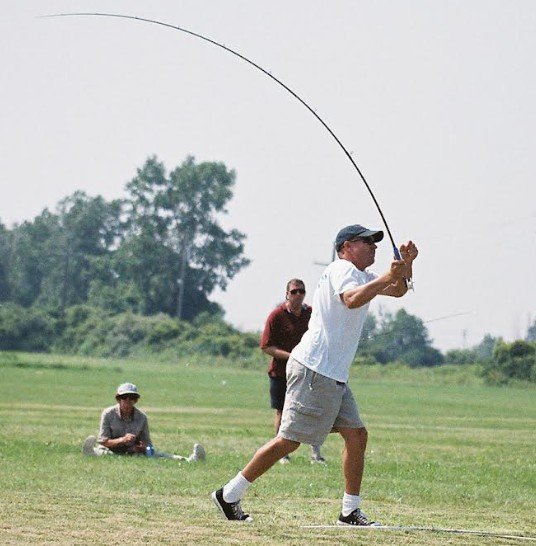
Angler’s Fly Distance has its name because it uses equipment anglers might use wherever extra distance is needed that would be difficult to achieve with ordinary single-handed outfits. The rod is just above 9 feet. A 10-weight shooting head is the maximum allowed. The running line must be at least 0.015 inch thick, i.e. strong enough to fight a decent sized fish with it. With this type of equipment and some basic distance casting skills, casts beyond 100’ are common. Top casters can cast 150 feet (and a lot more with wind). The ACA’s women’s record is 150 feet and the men’s is at 190!
Angler’s Fly Distance is an ACA recognized event that must be scheduled at all National Tournaments. Check out the detailed rules on page 26 of the Rules and Tournament Regulations.
Trout Distance (ICSF)
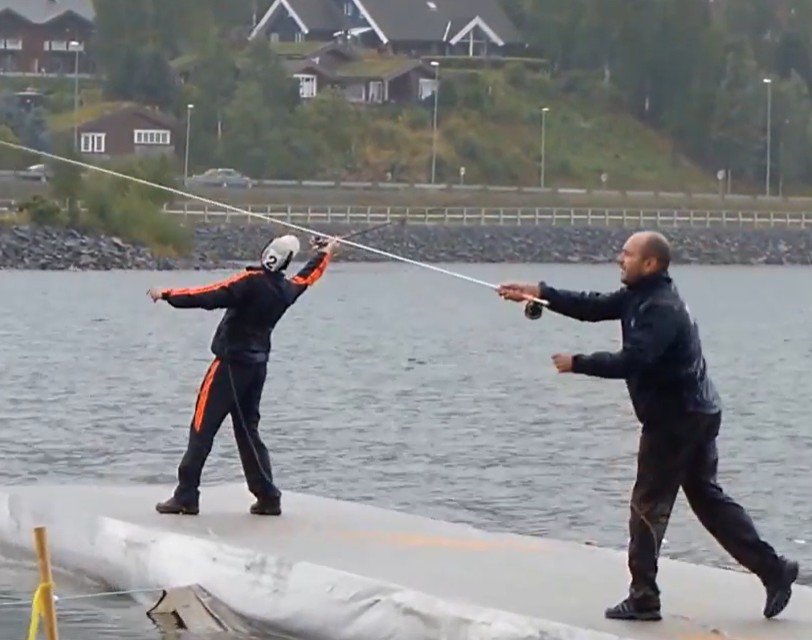
The Trout Distance game is popular for a number of reasons. It uses standard equipment in a 9-foot rod and a 5-weight line plus it has a history of being cast by average anglers and semi-professionals alike at fishing shows. This exposure and the straightforward equipment give this game a broad base. Almost anyone can try it. This is not to say that it doesn’t take lots of practice to be among the top casters. Since the fly line is very long, this game is not a shooting head game. Hence, one has to learn the skill to falsecast a lot of line - and then shoot some more.
Trout Distance is an ACA special event that is optionally scheduled at all National Tournaments. Check out the detailed rules on page 7 of the ICSF Flycasting rules.
Spey Distance 15-ft (ICSF)
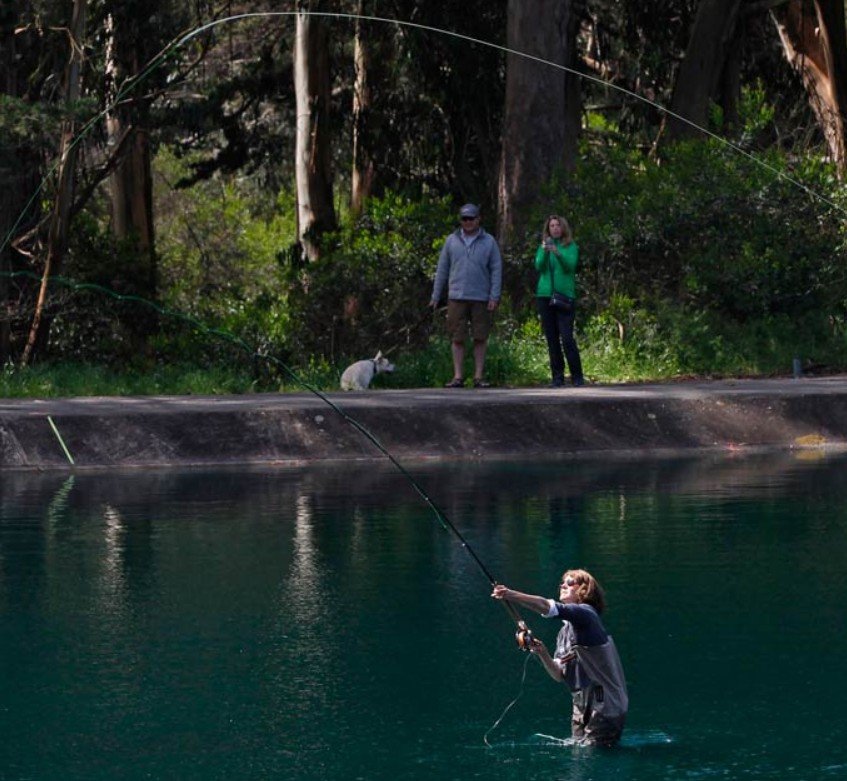
Two-handed flycasting - Spey casting especially - has seen an increase in popularity. It is not surprising that casters came up with games that test and compare their Spey casting skills. This is the one where casters are allowed the use of 15-foot rods. Casters stand in the water (around 2 feet deep) while making Spey casts requiring a change of direction. The ICSF version of this game requires cast from the left to the right over the right shoulder and from the right to the left over the left shoulder - called right- and left single-Spey casts. This makes this game unique in requiring both left- and right-handed casting. The lines are shooting heads with a taper specialized for Spey casting, i.e. for casting forward without allowing the fly to go behind the caster (where it could tangle with obstructions). There is a version of this game with so-called ‘Spey-o-rama rules’ where left and right snake-roll casts are also required (additional differences apply).
Check out the detailed rules on page 9 of the ICSF Flycasting rules. Look here for the Spey-o-rama rules.